Plumber Questions From Jefferson City Homeowners
Plain replies to what homeowners here ask us most, sorted by topic so you can find yours quickly.
Read the answersJump to a topic
Each repair page also has its own questions. These pages go deeper on the topics below.
Questions about plumber visits in Jefferson City
If your question is not here, the answer is usually one phone call away.
How does a visit start?
Describe the trouble, the room and roughly when it began. From that the plumber knows which parts and tools to load.
A licensed plumber who works in Jefferson City then comes out, looks at the problem in person and explains what is wrong before touching anything. If the problem turns out to be bigger or smaller than it sounded, you hear that too.
Will I know what the work involves before it starts?
Yes. You hear which part gave out, how the plumber would fix it, how long the water stays off and any options, such as mending a part or swapping the fixture.
The work waits for your yes. Wanting a day to think or a talk with family is fine, and the plumber can leave notes about what was found.
Why does a licensed plumber matter for a repair?
Every plumber who comes to your home is licensed and works in Jefferson City, and you are welcome to see the license on arrival. Licensed plumbers follow the plumbing code for things like gas connections, water heater venting and relief valves, which matters for safety as much as for the repair itself.
Which parts of Jefferson City do you cover?
All of Jefferson City, Missouri, including homes in the 65101 and 65109 ZIP codes. Older brick houses, newer builds, homes with basements and homes on crawl spaces or slabs are all covered. Unsure whether your street falls inside the city limits? Give us the address and we will check.
Does someone have to be at the house?
Yes, you or a grown member of the household who can let the plumber in, show where the problem is and agree to the work.
The plumber often needs to turn the water off and on again, check other fixtures and explain the options, so someone who knows the house makes the visit go smoothly. A tenant can be there if the owner has agreed to the repair.
How can I get ready for the visit?
With water escaping, shut the closest valve, or the main one when no closer valve turns up, and switch off breakers for any wet room.
Clear the area around the problem, such as the cabinet under the sink or the space in front of the water heater. Keep pets in another room, and write down anything you noticed, like sounds, smells or when the problem started.
What counts as a plumbing emergency?
Water spraying from a pipe, water coming through a ceiling or a light fixture, a water heater leaking steadily, or no water at all on a freezing morning.
Each of these can cause serious damage within hours. Close the main valve, cut power to wet rooms and call. Our plumbing emergency checklist lays out each move in order.
Where is my main water shutoff valve?
Look where your supply line passes into the house, normally on the street side. Basement homes tend to have it near the floor on that wall.
In a crawl space home it may be just inside the access or under the kitchen sink. Our main shutoff guide shows the common spots and explains how to close a ball valve and a gate valve.
Does wind make pipes freeze faster?
Yes. Wind pulls warm air out of wall cavities and crawl spaces, so a pipe near an exterior wall can freeze on a windy night that would be safe if the air were still.
Seal drafts around the crawl space and the sill, open sink cabinets on exterior walls and leave a thin stream running when the forecast is bitter. Our winter pipe care guide covers each step.
How can I tell a pipe has burst inside a wall?
Wet patches low on a wall, paint that bubbles or peels, a hissing or running water sound with every tap off, or a water meter that keeps moving.
After a freeze, the leak often starts only when the pipe thaws, so watch the walls closely on the first warm morning. Close the main valve as soon as you suspect it.
Why is my water pressure suddenly low?
When only one tap is weak, grit has likely packed the small screen at the end of the spout. Twist it off and rinse it.
If the pressure is low everywhere, the main valve may be partly closed, a pipe may be frozen on a cold morning, or the water line from the street may be leaking. A plumber can check the pressure and trace the cause.
How do I find a hidden leak?
Leave every tap and appliance idle and keep an eye on the meter for about an hour. If the reading changes, water is leaking somewhere.
Close the toilet valves and test again, because a running toilet is the most common silent leak. If the meter still moves, the leak is in a pipe, a fixture or the water line, and our leak signs guide explains what to look for.
What keeps my toilet running?
Most often the rubber flapper has worn and lets tank water seep into the bowl, so the tank keeps refilling. A float adjusted too high can also spill water into the overflow pipe.
Tint the tank water with dye and colored water in the bowl within fifteen minutes points to the flapper. Both parts are simple to replace.
Is a dripping faucet worth fixing?
Yes. Even a slow drip adds up to a lot of water across a year, and it speeds up as the part keeps wearing.
Most drips come from a cartridge, a washer or a seat inside the faucet, which the plumber can replace in a short visit. If the faucet body itself is corroded, replacing the whole faucet may make more sense.
Why does my sink drain slowly?
In bathroom sinks, hair and toothpaste collect around the stopper and in the trap. In kitchen sinks, grease and fine food scraps coat the pipe walls.
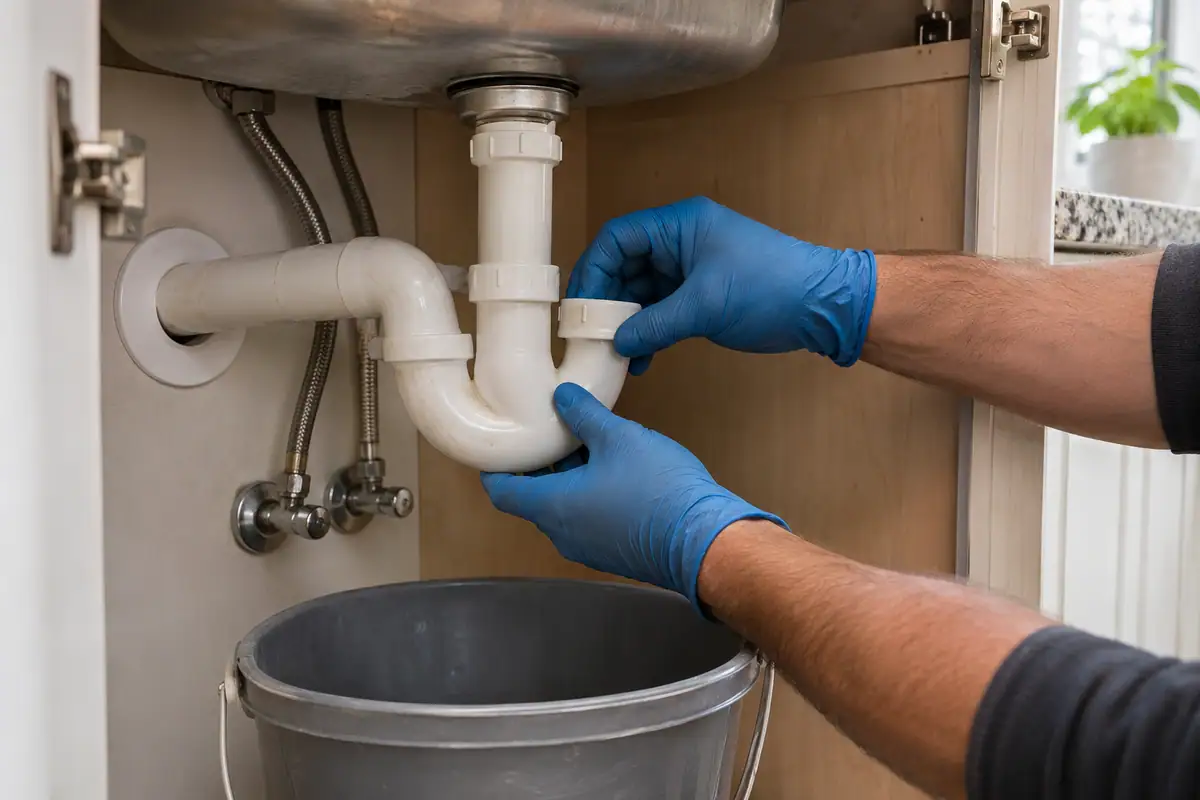
Cleaning the stopper, using a cup plunger and opening the trap under the sink clears most of them. If the same sink keeps slowing down, a plumber can clear the pipe past the trap.
Are chemical drain cleaners safe?
We suggest skipping them. Strong drain chemicals can soften older pipes and seals, rarely clear a solid clog and leave caustic water sitting in the drain for whoever opens the trap next.
A plunger, a plastic drain tool or a plumber with a hand snake clears clogs without that risk. Hair catchers and sink strainers prevent most clogs in the first place.
What does it mean when several drains back up at once?
Two or more fixtures backing up together, or water rising in a floor drain while the washer runs, the blockage is likely in the main line rather than in one drain. Stop running water and do not flush. That is a separate job from household drain cleaning, and we can tell you who handles it.
Why is there no hot water?
On a gas tank, the pilot may have gone out, often because the thermocouple has failed. On an electric tank, check the breaker and the reset button.
A breaker that keeps tripping, or a pilot that refuses to stay lit, means a part has failed. Our water heater repair page lists the common causes for both types of tank.
Why does my water heater make popping sounds?
Grit carried in the water collects on the tank floor. Heat from the burner or elements makes water burst up through that layer with a pop. Flushing the tank once a year reduces the sediment, quiets the noise and helps the tank heat evenly. Our flushing guide explains the steps.
What are the signs a water heater is wearing out?
Water seeping from the tank body, rusty hot water, rumbling that a flush no longer quiets and repairs that keep coming back all point to a tank near the end.
Age matters too, since most tanks give roughly ten years of service. The plumber can tell you whether a repair or a replacement makes more sense.
Can you repair older plumbing?
Yes. Older homes often have galvanized pipes, older gate valves and fixtures that are no longer made.
The plumber explains which parts are worth repairing and which are close to failing, so you can plan rather than wait for a leak. Replacing a stuck main valve or a worn supply line is often a small job with a big benefit.
How do I know if my outdoor faucet split over the winter?
Often nobody knows until the first spring use, when water pours into the wall cavity instead of out of the spout. Look at the basement wall behind the faucet the first time you run a hose. A frost free outdoor faucet, with the hose disconnected each fall, helps prevent the problem next winter.
Do you replace fixtures?
Yes. When a toilet, faucet or water heater is past repair, the plumber can replace it after explaining the options. You hear why a repair no longer makes sense before anything is replaced, and you decide which way to go.
Can I email instead of calling?
Yes. You can reach us by email for questions that are not urgent, such as planning work before winter. For leaks, flooding and emergencies, calling is the better choice so a plumber can be sent out.
What is the difference between a frozen pipe and a burst pipe?
A frozen pipe is blocked by ice, so water stops flowing. A burst pipe has split, usually from the pressure of that ice, and leaks once it thaws. Thawing a frozen pipe early, gently and without a flame is the best way to stop it becoming a burst pipe.
Why does my toilet run after I flush and then stop much later?
The fill valve may be slow to shut off because of debris or wear, or the flapper may close slowly and let water keep flowing. Both are simple parts for a plumber to replace, and they waste a lot of water if left.
Do I need a plumber for a new washing machine hookup?
If the valves and drain are already in place, many homeowners connect a washer themselves. If the valves leak, are stiff or the drain is slow, the plumber can replace the valves and clear the standpipe first.
How can I make my plumbing last longer?
Know where your main valve is, keep grease and wipes out of drains, flush the water heater once a year, prepare pipes for winter and fix small drips early. Most big repairs start as small problems that went unnoticed.
Why is my water heater leaking from the top?
A leak at the top usually comes from a loose fitting on the hot or cold pipe, the relief valve or its pipe. Those are often simple repairs. A leak from the tank body at the bottom is more serious and usually means replacement.
Do you work on weekends?
Ask when you call. Describe the problem and we will tell you what we can do and when.
Can you help if I already tried to fix it myself?
Yes. Tell the plumber what you tried, such as a drain cleaner or a new part, so it can be checked safely. There is no need to undo anything before the visit.
Still have a question?
Tell us what is happening at home and we will explain the next step, or send a licensed plumber who works in Jefferson City to look at it.
See how to reach us- Licensed plumbers
- Plain answers
- Every Jefferson City ZIP code